Inventory management is a critical operational function that underpins business performance across manufacturing, logistics, and retail sectors. However, many facilities continue to expend enormous amounts of time and cost on manual or barcode-based stocktaking processes.
RFID-based inventory management systems represent an innovative solution capable of reducing stocktaking time by up to 95% and achieving inventory accuracy of 98% or higher. This article provides a thorough explanation of RFID inventory management—from the underlying mechanisms and implementation steps to cost estimation.
How RFID Inventory Management Systems Work
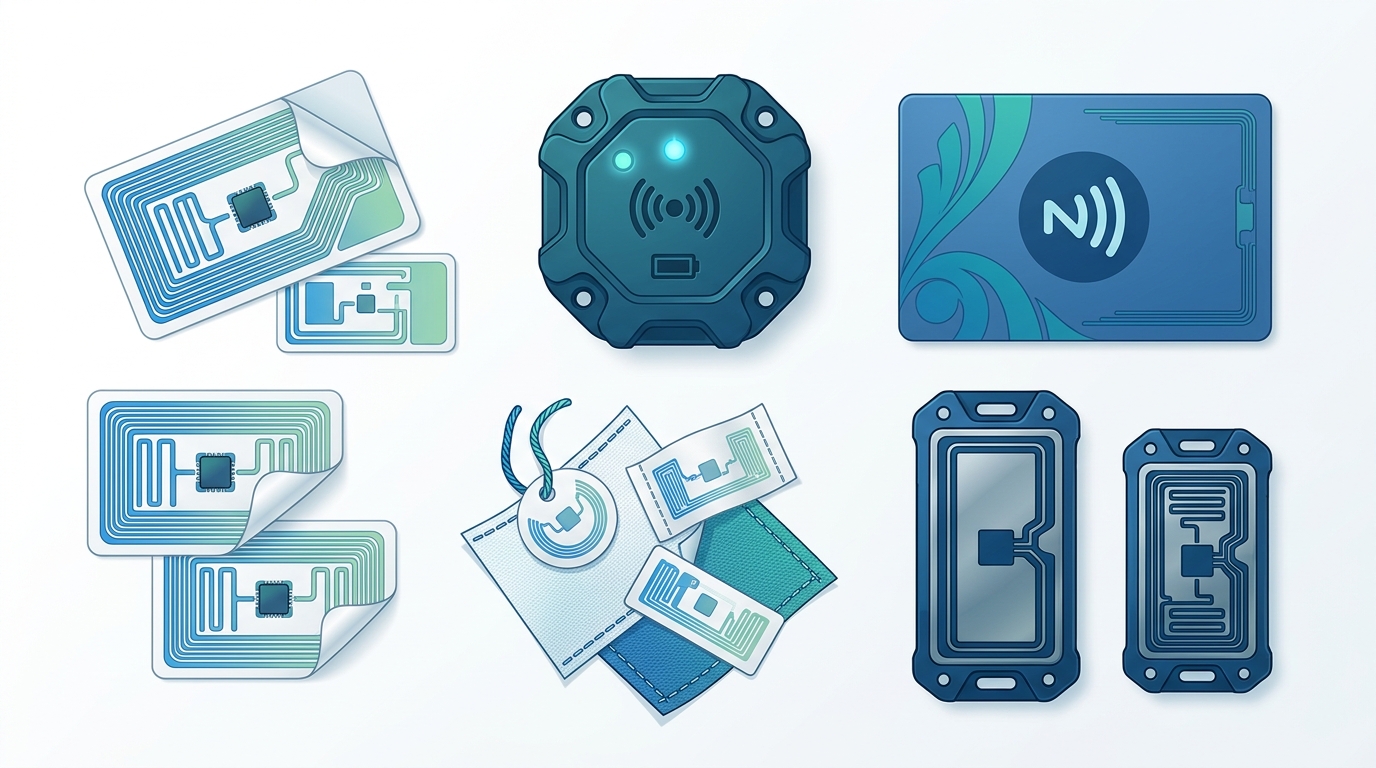
An RFID inventory management system consists of three core components: RFID tags, RFID readers, and a WMS (Warehouse Management System).

| Component | Function | Primary Types |
|---|---|---|
| RFID Tag | Affixed to individual items to store unique IDs | Passive tags (UHF band), Active tags |
| RFID Reader | Reads tag data contactlessly | Handheld, Gate/Portal, Fixed |
| WMS Integration | Manages read data in real time | Cloud-based, On-premises |
:::info-box
Because RFID tags communicate via radio waves, entire carton contents can be scanned without opening the box. Unlike barcodes, which require individual line-of-sight scanning, hundreds of items can be read in a matter of seconds.
:::
The overall data flow is as follows:
- RFID tags are affixed to products (at goods receipt or at the manufacturer's facility)
- Gate/portal readers automatically capture data at inbound and outbound points
- Handheld readers perform bulk scanning during stocktaking
- The WMS updates inventory counts in real time
- A dashboard provides visibility and analysis of inventory status
Barcode Management vs. RFID Management: A Comparison
The following table compares conventional barcode management with RFID management across key performance indicators.

| Criteria | Barcode Management | RFID Management |
|---|---|---|
| Read Speed | Individual items (~5 sec/item) | Bulk reading (hundreds of items/sec) |
| Read Range | Contact to a few cm | Up to 10 m (UHF band) |
| Line of Sight | Label must be visible | Not required |
| Stocktaking Time | 8–16 hours (1,000 SKUs) | 30 min–1 hour (1,000 SKUs) |
| Inventory Accuracy | 85–95% | 98–99.9% |
| Initial Cost | Low | Medium–High |
| Running Cost | Low | Tag cost incurred |
| Environmental Resistance | Vulnerable to soiling | Strong except for metal and liquid |
:::warning-box
RFID is not a universal solution. Tag read accuracy may degrade in proximity to metal products or liquid containers. A PoC (Proof of Concept) in the actual facility environment must be conducted prior to full deployment.
:::
RFID Inventory Management Implementation Steps
RFID inventory management is implemented in the following five phases.
Step 1: Requirements Definition (1–2 months)
Conduct a thorough review of the current inventory management workflow and clearly define the challenges to be addressed by RFID. Consolidate the number of SKUs to be managed, warehouse floor area, inbound/outbound frequency, and integration requirements with existing systems.
Step 2: PoC (Proof of Concept) (1–2 months)
Conduct small-scale testing in the actual facility environment. Validate read accuracy, communication range, and interference with metal and liquid materials, and calculate projected ROI.
"Proceeding to full deployment without a PoC is the most common failure pattern to avoid. Unexpected issues frequently surface during real-environment validation, making a PoC an essential step."
Step 3: Tag Selection and Procurement (1 month)
Based on PoC results, determine the optimal tag type, size, and placement position. For high-volume procurement, negotiating unit pricing is also an important consideration.
Step 4: System Build-Out (2–3 months)
Carry out WMS integration development, reader installation work, and operational manual preparation. Design data integration with existing core systems (ERP) as well.
Step 5: Go-Live and Tuning (1–2 months)
Begin operations in a phased manner, optimizing read accuracy and workflows over time. Conduct parallel training for floor staff.
:::success-box
The estimated total implementation timeline is 6–10 months. Confirming effectiveness through a PoC before proceeding to full-scale deployment significantly reduces the risk of failure.
:::
Key Considerations for Implementation
To ensure a successful RFID inventory management deployment, keep the following considerations in mind.
Addressing Metal and Liquid Environments
UHF band RFID signals are reflected by metal surfaces and absorbed by liquids. These challenges can be mitigated by selecting metal-mount tags (on-metal tags) or liquid-tolerant tags as appropriate.
Optimizing Tag Placement
Tag placement position has a significant impact on read accuracy. Use the PoC phase to identify the optimal placement for each product type based on its shape and material composition.
Integration with Existing Systems
Data integration with ERP and WMS platforms is typically implemented via API. Determine during the requirements definition phase whether real-time integration is required or whether batch processing will suffice.
:::point-box
The key to a successful deployment is to "start small and scale broadly." Begin with a single warehouse or product category, confirm results, and expand incrementally.
:::
Cost Estimation Model
Implementation costs for RFID inventory management vary considerably depending on the scale of deployment. The following provides approximate cost ranges by scale.

| Cost Item | Small Scale (~5,000 SKUs) | Medium Scale (~50,000 SKUs) | Large Scale (50,000+ SKUs) |
|---|---|---|---|
| RFID Tags (initial) | ¥500K–¥1M | ¥2M–¥5M | ¥5M–¥20M |
| Reader Hardware | ¥1M–¥3M | ¥3M–¥8M | ¥8M–¥30M |
| System Development | ¥2M–¥5M | ¥5M–¥15M | ¥15M–¥50M |
| Implementation Support & Training | ¥500K–¥1M | ¥1M–¥3M | ¥3M–¥10M |
| Total | ¥4M–¥10M | ¥11M–¥31M | ¥31M–¥110M |
| Annual Tag Cost | ¥300K–¥600K | ¥1.2M–¥3M | ¥3M–¥12M |
| ROI Payback Period | 1–2 years | 1.5–2.5 years | 2–3 years |
:::info-box
The market price for passive UHF tags is typically ¥5–¥20 per tag. Unit costs can be reduced through volume ordering, with prices falling below ¥5 per tag for annual orders exceeding one million units.
:::
RFID Inventory Management Success Stories
Case Study 1: Major Apparel Manufacturer, Company A
Deployed RFID inventory management across 200 stores nationwide. Stocktaking time was reduced from 16 hours to 45 minutes (approximately 95% reduction). Inventory accuracy improved from 93% to 99.2%, and the out-of-stock rate decreased by 60%.
Case Study 2: Medical Device Manufacturer, Company B
Leveraged RFID for traceability management of surgical instruments. Instrument location confirmation time was reduced from an average of 30 minutes to 2 minutes. Automated recording of sterilization history also significantly reduced compliance-related costs.
Case Study 3: Logistics Warehouse Operator, Company C
Deployed RFID gates for inbound and outbound management at an e-commerce fulfillment warehouse. Goods inspection time was reduced by 70%, with mispick rates lowered to below 0.1%. Training costs for temporary staff during peak seasons were also reduced.
Summary
RFID inventory management is a powerful solution that simultaneously delivers dramatic reductions in stocktaking time and significant improvements in inventory accuracy. While the initial investment is substantial, ROI payback within 1–3 years has been achieved across many organizations.
The three key factors for a successful deployment are:
- Validate effectiveness in the actual facility environment through a PoC
- Deploy incrementally, starting at a small scale
- Design seamless integration with existing systems from the outset
For organizations seeking to improve inventory management efficiency, we recommend starting with a small-scale PoC. RFID implementation has the potential to elevate your inventory management operations to the next level.